

A true Bonedi groom does not follow the season; he upholds the lineage. The classic Bengali wedding ensemble is an exercise in intentional minimalism. It is where the crispness of hand-spun silk meets the geometry of the 'Kochano Dhuti,' creating a silhouette that is as regal today as it was a century ago. At Sujatam, we do not just tailor kurtas; we preserve the aesthetic of the Bengali Babu—refined, articulate, and timeless

For the couple whose union is a confluence of heritage, your excellent Kadhua Kodiyal Banarasi deserves an equal pairing of sartorial distinction. When the bride chooses the intricate, stand-alone motifs of a Kadhua weave, the groom’s ensemble must mirror that same dedication to raw purity and structural grace. At Sujatam, we articulate this balance through our high-quality Tussar silk dhuti-panjabi sets, where the earthy, organic luster of wild Tussar creates a sophisticated, understated harmony with the regal sheen of pure Banarasi silk. It is not merely a coordination of color, but a deliberate alignment of textures—ensuring that your presence together is a seamless, classic reflection of Bengali Bonedi elegance.


Coordinating the Palette: The Art of the Red
The pairing of a Tussar dhuti-panjabi with a traditional bridal Banarasi—whether in the deep, auspicious 'Bengal Red' or the rich, vermillion-tinted 'Dalhousie Red'—is a masterclass in color theory.
-
Textural Balance: The raw, matte texture of Tussar provides the perfect visual anchor for the intense, glossy brilliance of a bridal Banarasi.
-
The Golden Ratio: Because Tussar naturally carries a muted, pale-gold undertone, it inherently bridges the gap between the bride’s vibrant red and the intricate gold-thread Zari of her saree, creating a unified, harmonious color story rather than a jarring contrast.
-
Bonedi Harmony: This combination honors the traditional Bonedi preference for "coordinated elegance," where the groom complements the bride’s central vibrancy with a sophisticated, light-reflecting neutrality that keeps the focus on the union itself.
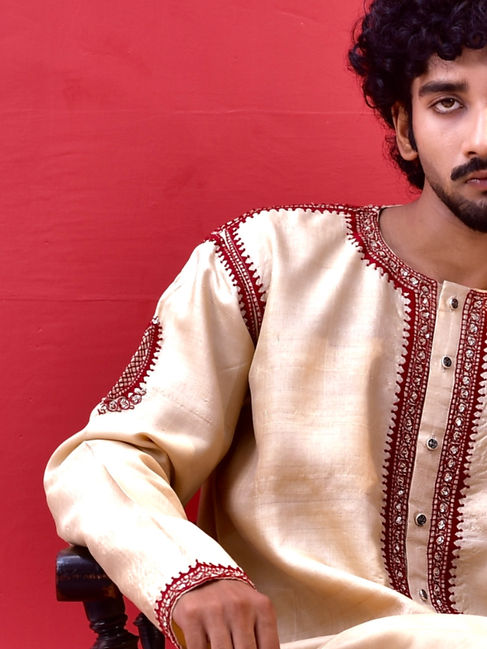

The Silhouette of Authority: Choosing Your Bonedi Style
The distinction of a true Bengali gentleman lies in the architecture of his ensemble—the specific cut that commands a room without uttering a word. Historically, the Bonedi Babu understood that style was not merely about fashion, but about poise and cultural alignment. Whether you choose the regal heritage of the Angrakha, the structural discipline of the Front Placket, or the understated sophistication of a Side Open design, each style carries a distinct narrative of the Bengali aristocratic past.

-
The Angrakha: Historically associated with the fusion of Mughal refinement and Bengali grace, the Angrakha—with its overlapping, tie-up construction—was the preferred choice for formal gatherings and wedding festivities. It speaks to a heritage of indulgence and leisure, offering a layered, sculptural aesthetic that creates a more voluminous, authoritative presence.
-
The Front Placket (The Classic): The vertical center-placket panjabi is the quintessential attire of the scholarly and professional Babu. It represents modern heritage—straightforward, disciplined, and impeccably sharp. It is the style that best highlights the texture of premium handloom fabrics like Tussar, allowing the material’s natural luster to take center stage without the distraction of complex tailoring.
-
The Side Open (The Asymmetric Aesthetic): Often favored for its clean, minimalist lines, the side-open style subtly subverts traditional expectations. Rooted in a quieter, more artistic expression, it remains a favorite for those who value 'Quiet Luxury'—it offers a seamless look that allows for a cleaner drape when paired with the intricate pleats of a Kochano Dhuti.
Whether your preference leans toward the regal layers of the Angrakha, the disciplined precision of a classic front placket, or the subversive elegance of a side-open drape, the true Bonedi look is found in the fit. At Sujatam, we do not simply offer ready-to-wear; we offer a study in your own proportions. We invite you to a private styling consultation at our Mahanirban Road studio, where we will discuss your silhouette, select the perfect Tussar or Khadi silk, and tailor a masterpiece that honors your heritage.


The Elegance of White: The Absolute Bonedi Choice
For the groom who seeks to embody the timelessness of the Bengali gentleman, pure white handloom silk offers a singular, luminous appeal that defies the passage of trends. Historically, a white silk panjabi—often crafted from fine mulberry silk or delicate Khesh—was the mark of a man who commanded presence through stark, minimalist brilliance. When paired with a meticulously pleated Kochano Dhuti in a matching ivory or eggshell, the monochromatic palette allows the texture of the weave and the precision of the tailoring to speak for themselves. This is the hallmark of the summer wedding or the morning ritual: it captures the light with a soft, ethereal glow, creating a silhouette that is at once celebratory, pristine, and profoundly sophisticated. White silk is not just an alternative to Tussar; it is the definitive choice for the groom who wants his personality, rather than his ornamentation, to be the focal point of the ceremony.